As you walk around towns all over Europe, but especially in Germany, you will “stumble” across a number of brass stones in the sidewalk. These are Stolperstein, or Stumbling Stones, and they are laid in front of the houses where people who became victims of the Holocaust lived – Jews, homosexuals, the disabled, and the Romani (nomadic peoples). The stones are inscribed with the person’s name, birthday, death date, and where they were taken; sometimes the stones are alone, and sometimes in a cluster, in case of a family or multiple families in one building.
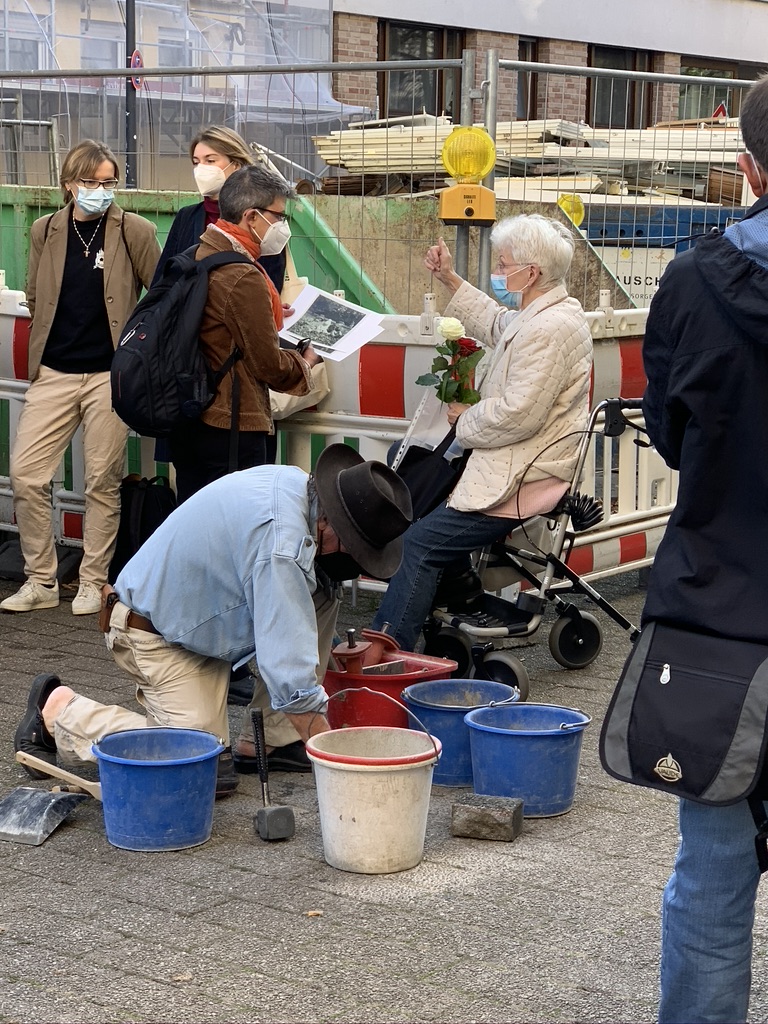
Today I got a chance to see the artist who lays the stones, Gunter Demnig, along with a beautiful ceremony to honor the memory of a victim who lived in the East End of Frankfurt. Mr. Demnig is 70 years old and started this project in the 1990s. He has laid over 80,000 of these memorial stones in 21 countries across Europe, making it the largest memorial in the world.

There was a small crowd to witness Mr. Demnig laying the stone, and lovely flute music to open and close the ceremony. The victim’s sister was there, along with a few other family members, and they had brought old brown-and-white family photos of the victim’s youth. One of them spoke some words about the victim – it was mostly in German, of course, so I only caught some of the story – apparently the victim was a girl who was sent to a mental institution because she was born with health issues, and euthanized there by the Nazi medical system during World War II.
It was really sad but beautiful, and I was so impressed by how understated the artist was – he simply got out his tools, dug out the existing brick, laid the brass stone, and got back in his van to go on to the next location (he was doing about 10 locations in Frankfurt today). Clearly, this was about the remembrance of the victims, and not about the artist himself. The other thing that struck me was how powerful this memorial is – despite the Nazi efforts to erase the existence of the groups they didn’t like, now these people will quite literally be remembered, and prayed over, forever. What a wonderful rebuke of a horrible regime.
I have stumbled across these stones all over Frankfurt and the surrounding mountain towns, and I’ve said a prayer, and an apology, over each and every one. I’m so very glad I got to see the artist at work, because now when I see the Stolperstein, I’ll think of him and the people he has honored with his art.


 Newmans in a New Land